


- Home
- About SAIMM
- Membership
-
News
- News
- Market News
- Multimedia
- Events
- Publications
- YPC
- Other Organisations
- contact us
- You are here:
-
Home

-
Events
-
Upcoming SAIMM events
- Modern Workflows for Tunnelling: RSLog for Investigation and RS3 for 3D Modelling
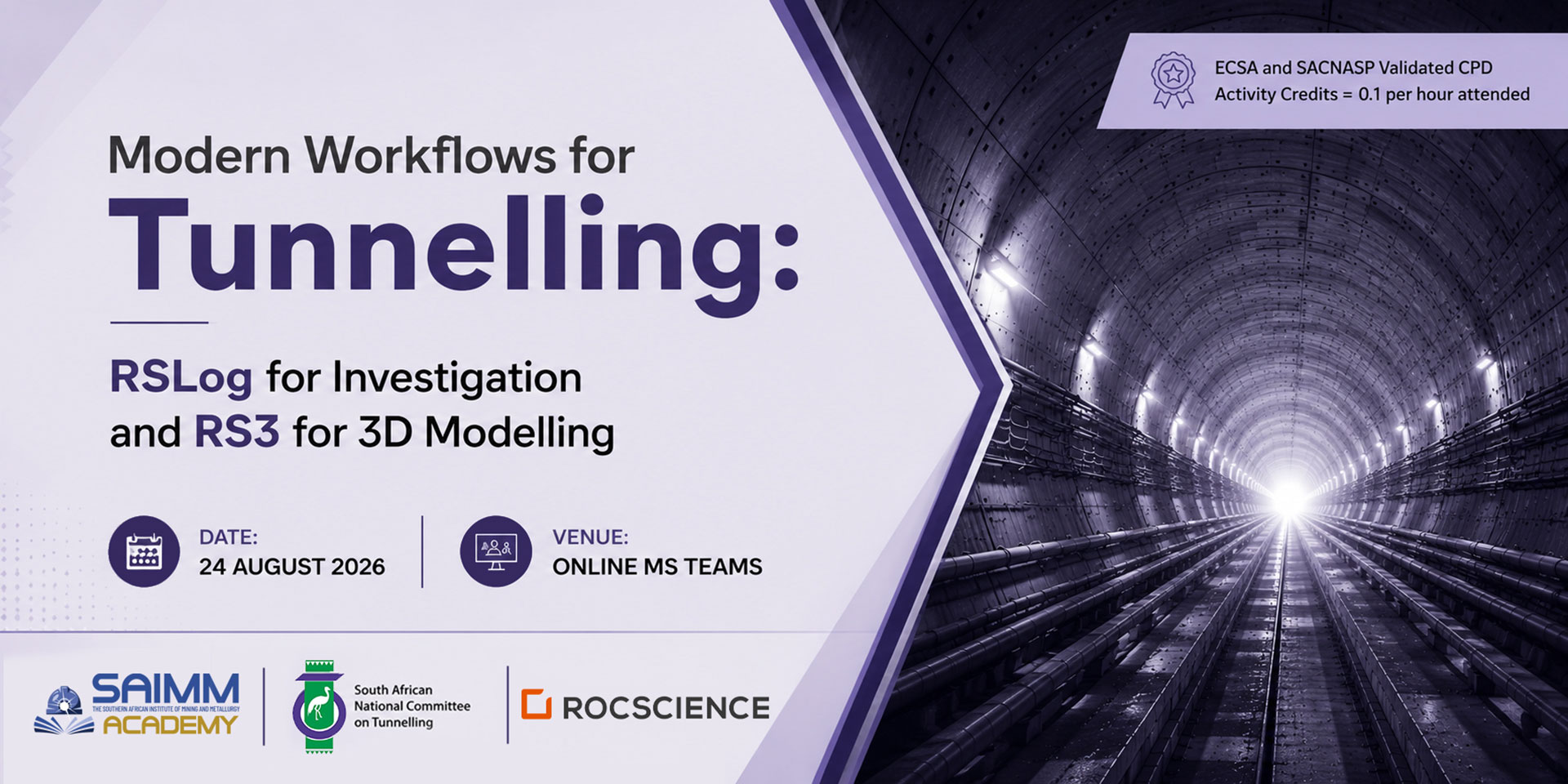
| Date | 24 August 2026 |
| Resources | Roc Science Workshop Announcement 16072026.pdf |
- OVERALL COURSE DESCRIPTION
- Suggested Audience
- Learning outcomes
- schedule
- Registration Fees
- Register
- contact
- OVERALL COURSE DESCRIPTION
- Suggested Audience
- Learning outcomes
- schedule
- Registration Fees
- Register
- contact
OVERALL COURSE DESCRIPTION
This two-part online workshop introduces the practical application of Rocscience RSLog and RS3 for tunnel planning, design, and analysis. Participants will learn how to move from investigation data and borehole logs through to 3D finite element modelling of tunnelling sequences, support design, and interpretation of results for tunnelling projects. The workshop will emphasize real-world workflows relevant to Southern African tunnelling practice, including data management, geological model development, staged excavation, and support performance in heterogeneous rock masses. By the end of the workshops, attendees will be able to set up and manage borehole data and logs in RSLog, develop a consistent ground model for tunnelling, build and analyze 3D tunnel models in RS3, and effectively communicate analysis outputs for design decisions and reporting.
Suggested Audience
- Engineering geologists and geotechnical engineers involved in tunnel investigations and design.
- Underground, mining and civil engineers working on tunnels, caverns and underground excavations.
- Designers and consultants who wish to integrate borehole data management and 3D numerical analysis in their tunnelling workflows.
Learning outcomes
After completing both workshop sessions, participants should be able to:
- Describe how RSLog and RS3 fit within the tunnelling project lifecycle, from investigation to 3D analysis.
- Use RSLog to manage borehole data, define stratigraphy and rock units, and generate engineering logs and cross-sections relevant to tunnel alignment selection.
- Export and use subsurface information from RSLog as input for 3D tunnel modelling in RS3 (conceptually or via available data exchange workflows).
- Build a 3D tunnel model in RS3, including geometry, staged excavation, in situ stress, and rock mass and support properties.
- Analyze key outputs from RS3 for rock tunnels (e.g., displacements, stresses, plastic zones, and lining forces) and relate them to design decisions and observational monitoring.
schedule
- Workshop 1 (4 hours): Ground investigation and rock tunnelling context with RSLog
- Workshop 2 (4 hours): 3D tunnel analysis in RS3 using a tunnel design workflow
WORKSHOP 1 (4 HOURS) – GROUND INVESTIGATION AND RSLOG FOR ROCK TUNNELLING
SESSION 1: TUNNELLING CONTEXT AND INVESTIGATION OBJECTIVES
- Overview of geotechnical information needs of tunnelling projects.
- Investigation objectives for rock tunnels: alignment selection, rock mass characterization, groundwater conditions, in situ stress indicators, and constructability risks.
- Where RSLog fits in the tunnelling workflow and how it complements numerical analysis tools such as RS3.
SESSION 2: INTRODUCTION TO RSLOG AND DATA MODEL
- RSLog as a cloud-based borehole logging and data management application: projects, boreholes, and user roles.
- Data structures: locations, elevations, lithology, samples and tests, groundwater, and observations relevant for tunnels (RQD, fractures, weathering, joint conditions).
- Demonstration: navigating the RSLog interface, creating a project, and defining a set of boreholes along a proposed tunnel alignment.
BREAK
SESSION 3: LOGGING FOR TUNNELS – LITHOLOGY, ROCK MASS AND GROUNDWATER
- Setting up lithology/stratigraphy templates and rock units suitable for rock tunnelling (e.g., jointed basalt, sheared zones, dykes, weak seams).
- Capturing discontinuity and rock mass data (RQD, joint spacing, condition) and test information that will inform design parameters in RS3.
- Entering groundwater information and water strikes, with discussion of implications for tunnel construction and support.
- Demonstration: populating boreholes, editing logs, and quality controlling investigation data within RSLog.
SESSION 4: CROSS SECTIONS, REPORTS, AND LINK TO ANALYSIS
- Generating borehole logs, fence diagrams, and geological cross-sections in RSLog to illustrate the ground model along and across the tunnel alignment.
- Using RSLog project summary reports to communicate investigation findings and design parameters.
- Conceptual link from RSLog to numerical modelling: how borehole and geological model outputs can be used to define geology layout and rock mass properties in RS3.
- Q&A and discussion of participants' tunnelling investigation challenges.
WORKSHOP 2 (4 HOURS) – RS3 FOR 3D TUNNEL ANALYSIS
SESSION 1: RS3 OVERVIEW AND TUNNELLING WORKFLOW
- RS3 - 3D finite element program for geotechnical and underground analysis, including tunnels and caverns.
- Review of the RS3 workflow tabs: Geometry, Excavations/Tunnels, Materials, Loads, Restraints, Mesh, Compute, and Results.
- Specific capabilities for tunnels: Tunnel Designer, staged excavation, liners and support, field stresses, and results visualization.
SESSION 2: BUILDING A ROCK TUNNEL MODEL
- Importing or creating rock mass geometry for the tunnel project, with layers and units based on investigation data.
- Using Tunnel Designer (with boreholes) to define tunnel alignment, shape, and segmentation appropriate for staging and different support regimes.
- Defining rock mass, fault/weak zone, and lining/support properties, consistent with data interpreted from RSLog and typical empirical correlations.
- Applying in situ stress conditions (e.g., gravity, user-defined principal stresses) relevant to deep or shallow rock tunnels.
- Demonstration: constructing a 3D tunnel model step by step in RS3.
BREAK
SESSION 3: STAGED EXCAVATION, SUPPORT, AND COMPUTATION
- Defining tunnel excavation stages and sequences, including advance lengths, face support, and multi-drift or pilot-heading approaches.
- Assigning liners, bolts or other supports along the tunnel perimeter using RS3's support tools, and sequencing installation relative to excavation stages.
- Applying boundary restraints using the RS3 auto restraint feature for underground models.
- Meshing strategy for tunnel models (element type, gradation) and running the finite element analysis.
SESSION 4: RESULTS INTERPRETATION AND DESIGN IMPLICATIONS
- Viewing and interpreting results: total displacement, stresses in rock, plastic zones, and lining forces versus design criteria.
- Comparing stages to assess the influence of excavation sequence and support timing on tunnel performance.
- Illustrating outputs for communication: section cuts along the alignment, contour plots, and exporting images/values for reports.
- Short example.
- Final Q&A and discussion on integrating RSLog and RS3 into local tunnelling practice.
Registration Fees
|
Early SAIMM/SAGA/GSSA Member |
500,00 |
|
Early Non SAIMM/SAGA/GSSA Member |
650,00 |
|
SAIMM/SAGA/GSSA Member |
650,00 |
|
Non SAIMM/SAGA/GSSA Member |
750,00 |
|
Students |
150,00 |
|
Retired Member |
150,00 |
Early bird valid until 3 August 2026
Registration closes on 19 August 2026. Please note late registrations will incur a R500 administration fee for registrations received after the closing date.
All prices quoted are exclusive of VAT
Register
Secure Your Spot for This Workshop
Register Nowcontact
FOR FURTHER INFORMATION CONTACT:
Gugu Charlie Conferences and Events Coordinator
E-mail: gugu@saimm.co.za
Tel: +27 11 538-0238
Web: www.saimm.co.za