The capability constraint we can no longer ignore: An open letter to CEOs, boards and leaders across industry, academia, and government


- Details
- Created: Thursday, 03 September 2026 09:01
- Written by G.R. Lane
 The capability constraint we can no longer ignore: An open letter to CEOs, boards and leaders across industry, academia, and government
To the CEOs, board members and leaders across industry, academia, and government who carry responsibility for the future of our minerals industry.
For the past 12 months, I have had the privilege of serving as President of the Southern African Institute of Mining and Metallurgy (SAIMM). As my term draws to a close, I feel a responsibility to write this open letter to the leaders who make decisions that will shape the capability of our industry for decades to come.
a year spent listening to mining professionals, executives, regulators, academics, and students, I have reached a clear conclusion: what we commonly describe as a skills shortage has become a much broader capability challenge. This will accelerate over the next decade as our experienced and capable cohort retires. The Mining Qualifications Authority Strategic Plan, tabled in March 2026, recorded 113 hard-to-fill mine manager vacancies and 107 mining engineer vacancies, with insufficient structured experience identified as the principal reason for the latter.
Producing more graduates alone will not solve this problem. What matters is turning talented people into capable practitioners who can make ethical and sound decisions, carry responsibility and apply their knowledge in demanding operating environments. Right now, our biggest challenge is conversion. Soon it will be replenishment.
South Africa has shown what long-term capability investment can achieve. Anglo American’s historical development programmes created a capability legacy that remains visible across mining and other industries, locally and internationally. In many of the rooms I enter today, I ask: “who has in some way been touched by an Anglo American development programme?” Generally, 50% of the people in the room put up their hands. Gold Fields is now establishing a ten-year capability-development programme on the West Rand through Siyakha Sonke. These examples are encouraging, but no single company can carry an industry-wide responsibility on its own.
Other mining jurisdictions have already recognised workforce capability as a strategic constraint on future growth. Canada has launched its Mining and Minerals Workforce Alliance. The United States has announced the nationwide PROSPECT initiative, supported by proposed funding of up to USD100 million. Australia has made workforce development a key element of its critical minerals strategy and established the government-funded Mining and Automotive Skills Alliance. South Africa needs a similar level of national focus through our critical mineral’s strategy, supported by commitment, broad collaboration, and collective leadership to drive capability delivery and impact.
The engineering pool Is smaller than many realise
Although 88% of full-time candidates passed the 2025 NSC, fewer than 4% would have met the commonly applied minimum threshold of 60% in both mathematics and physical sciences for engineering study—and the proportion satisfying universities’ complete admission requirements would be lower.
A recent analysis presented to our Minerals Education Ecosystem South Africa forum (MEESA) suggests that the annual figures equate to approximately 33 engineer-category matriculants per 10,000 public-school NSC writers. ECSA’s 2022 report, based on a cross-sectional analysis of 2020 data, recorded 3,239 engineer-category graduates against 725,034 NSC writers— approximately 45 per 10,000 across all engineering disciplines. The figures use different datasets and methodologies and are not directly comparable. Neither represents a tracked cohort, but both point to the same reality: the engineering pool is small.
Mining depends on every engineering discipline while competing with every other engineering-dependent sector and even the financial sector for the same scarce talent. The challenge extends far beyond engineers. It affects technologists, technicians, artisans, supervisors, and operators. If we are serious about building a sustainable industry, we must strengthen the entire workforce pipeline—from the shop floor to specialist and leadership roles.
From student bottleneck to licence-to-operate risk
Thirty-three final-year mining-engineering students will not graduate this year unless they secure the vacation work required by their curriculum. A further 275 third-year students also require workplace exposure. AMMSA has stepped forward to coordinate placements, but this should not depend on annual intervention. It should become part of a permanent industry operating model.
The statutory-certification pipeline presents an equally serious concern. In 2025, only five Certificates of Competency for mine surveyors were issued while seven experienced surveyors left the industry through retirement or attrition. The Institute of Mine Surveyors of South Africa (IMSSA) reported in August 2026 that 52% of its professional mine surveyors were over the age of 60. Taken together, these figures indicate a significant succession challenge and a growing licence-to-operate risk.
Industry feedback suggests that rock engineering may be constrained in the future, as our highly skilled individuals are being poached internationally and the mine-ventilation talent pipeline is lean.
These are not optional competencies. They sit at the heart of mining’s safety and legal framework.
The urgency is reinforced by ECSA’s implementation and enforcement of the Identification of Engineering Work Rules gazetted in March 2026. At the same time, Mine Health and Safety Act certification pathways do not align neatly with ECSA registration requirements and our mining industry roles and levels of work. Greater alignment is needed between industry, regulators, and professional bodies if we are to expand supervised development opportunities and strengthen these pathways.
Capability cannot be manufactured on demand
A qualification marks the beginning of professional formation, not the end of it. Experience cannot be developed overnight. Capability is built gradually through practical work, good supervision, exposure to different situations, mentoring, and increasing responsibility. Even with a structured development programme, a student entering their first year today may only reach full professional competence around 2036.
What SAIMM Is building
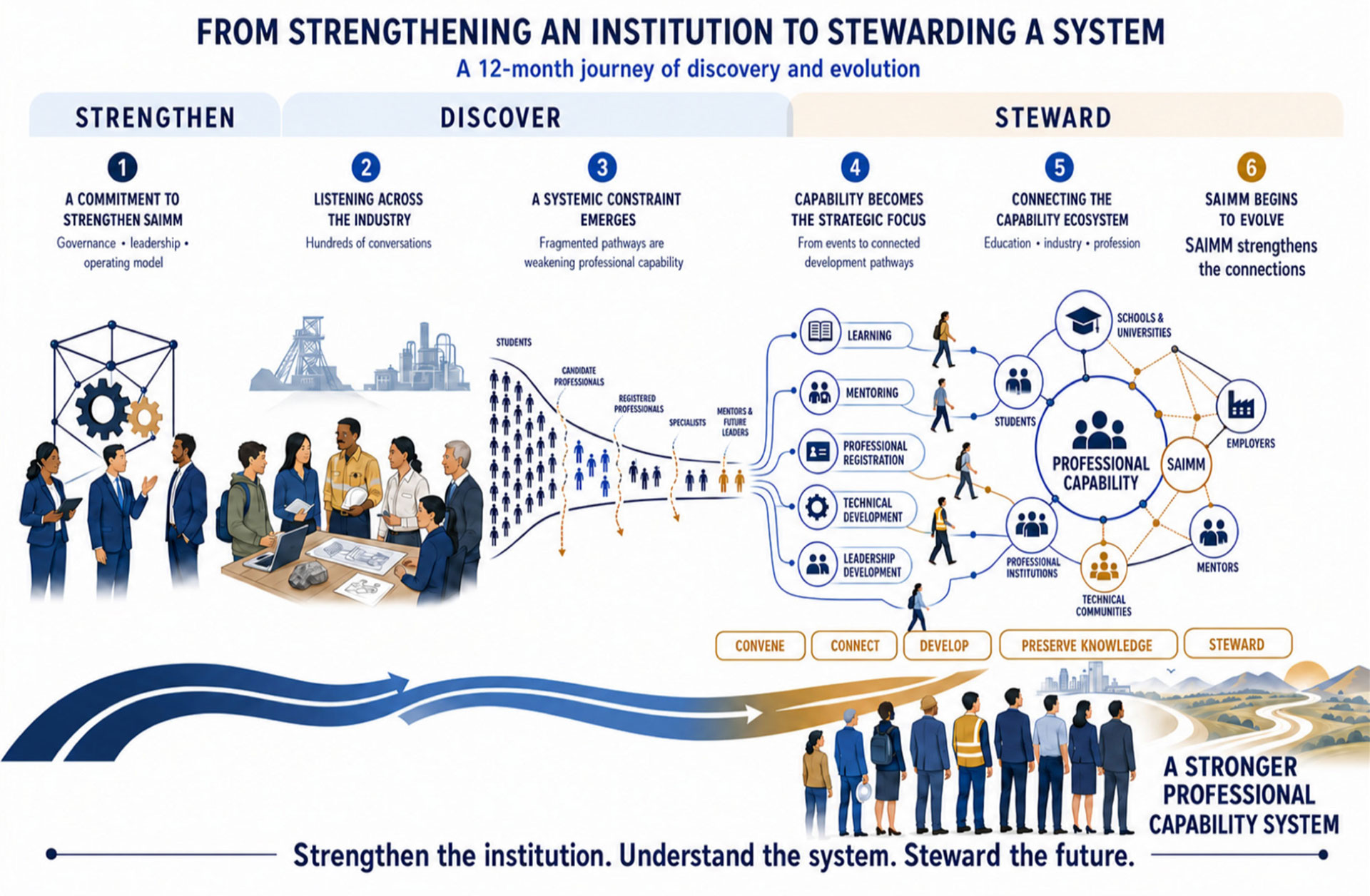
The SAIMM is working to connect and strengthen many initiatives that already exist across our industry. Approximately 350 volunteers from mining companies, consulting firms, and OEMs currently contribute through council, committees, and various programmes. Through the Minerals Education Ecosystem South Africa forum, the SAIMM Academy, the Continuing Professional Development Committee, the Young Professionals Council and our technical communities, we will work alongside the Institute of Mine Surveyors of South Africa (IMSSA), the Mine Ventilation Society of South Africa (MVSSA), the South African National Institute of Rock Engineering (SANIRE), the Mine Education Trust Fund (METF), Minerals Council South Africa, the Engineering Council of South Africa (ECSA), the Mining Qualifications Authority (MQA), universities, and employers to build an industry-approved graduate capability-development programme.
The objective is straightforward: create a structured pathway that helps graduates develop workplace competence, achieve professional registration and, where relevant, obtain statutory certification, while continuing to grow throughout their careers through professional development.
Put capability on the strategic balance sheet
The mining industry invests heavily in resources, infrastructure, and technology. Yet investment in the people required to design, operate, and improve those systems is often insufficient, particularly when market conditions deteriorate.
South Africa’s mineral endowment will only translate into sustainable value if we continue investing in the people who are responsible for turning mineral endowment into production and production into economic growth.
Boards should therefore look beyond annual training budgets and develop a clear view of a properly funded long-term capability strategy. Questions of succession, specialist depth, future demand, development capacity, and capability gaps deserve the same attention as other strategic risks.
My request Is specific
To CEOs and industry leaders: make capability development a strategic priority and an operating responsibility, investing in the full, integrated capability pipeline from education through work-integrated learning. Appoint an accountable executive to join MEESA, establish annual targets for workplace placements and mentoring, share workforce data, support multi-year funding commitments and align workplace skills plans and relevant SLP commitments with the long-term capability pipeline.
To boards: place capability on the strategic risk register and require annual reporting on pipeline conversion, specialist depth, professional registration, statutory certification, and succession, not only on training expenditure.
To government leaders: recognise mining as a pillar of economic growth and critical minerals as an opportunity of national significance and urgently create an enabling environment through aligned policy and incentives. Without deliberate intervention in STEM education, our country’s engineering capability will be at risk. Teacher capability, the STEM education pipeline, and industry capability development are interconnected challenges that require coordinated action. Strengthen mathematics and science teaching and improve alignment between education, workplace learning, professional registration, statutory certification, and workforce planning.
To the MQA: continue aligning the sector skills plan and SDL-funded grants with a demand-led capability pipeline. Prioritise workplace learning, technical and operator development, graduate programmes, and statutory competency pathways, while measuring placements, completions, certification outcomes, and employment.
To universities and TVET colleges: align curricula with current and future industry needs, identify workplace-learning requirements early, share pipeline and outcome data, and continue working with MEESA, employers, and professional bodies.
The SAIMM is changing its operating model and will invest in addressing this industry challenge as the steward of the professional capability ecosystem. We will continue bringing stakeholders together, helping to coordinate effort, track progress, developing the capability ecosystem, and reporting openly on both successes and gaps. Expect us to engage directly and to ask for measurable commitments around placements, mentoring, data sharing, and sustained support. This will also require an innovative funding model and collective leadership from the industry.
A responsibility that continues
This is my final President’s Corner. Its message has been shaped by an extraordinary council, committee chairpersons, and volunteers, as well as leaders from industry, academia, and our secretariat. I remain deeply grateful for their support and commitment.
Although my role will change, my commitment will not. A presidency lasts twelve months. Rebuilding capability takes a generation. Our future depends on developing people who can transform mineral resources into safe, responsible, and sustainable value for society.
The question before us is simple: will we continue to treat capability as somebody else’s problem, or will we accept collective responsibility for the people on whom the future of this industry depends?
G.R. Lane
President, SAIMM